Chapter one
Dōgen, and the cook's question
1200–1253 · Kyoto, Ningbo, Echizen
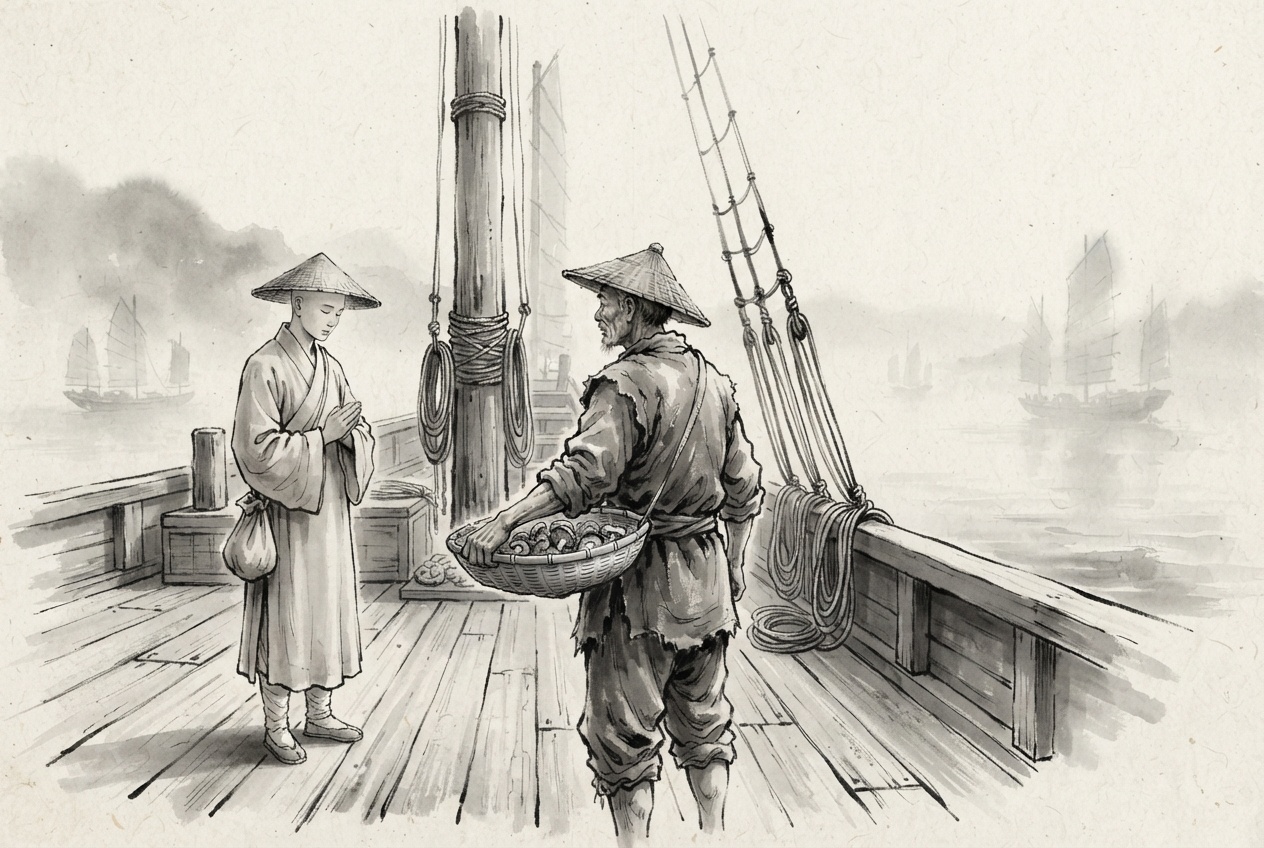
In the spring of 1223, a Japanese monk of twenty-three stood on the deck of a ship in the harbour at Ningbo, on the coast of southern China, waiting for permission to go ashore. The paperwork was slow. For weeks the ship could not move, and its passengers could not leave it.
We know what such a wait was like, because men wrote it down: bad water, a cramped hold, the smell of a cargo of Japanese timber. Dōgen had left Kyoto to look for something he could not put into words, and the first months of his search were spent standing still on the water.
One day an old man came aboard to buy dried mushrooms.
He was a cook — not a famous teacher, not a master with a lineage to defend, but the head cook of a monastery on Mount Ayuwang, some ten miles inland, whose work was three meals a day for several hundred monks. He was sixty years old. He had made the trip himself, and he was in a hurry to be back before the evening meal.
Dōgen asked why he had not sent a younger monk in his place.
The old man laughed at him. Others are not me, he said.
The answer survives because Dōgen wrote it down years later, in a short text addressed to the cooks of his own monastery. He wrote down his next question too, which was worse than the first. Surely, he said, there must be others in a monastery that size who could cook. Why should a man of sixty spend what time he had left on vegetables and rice? Was there not something better — sitting in meditation, perhaps, or studying the recorded sayings of the old masters?
He meant it kindly. He was also, without knowing it, asking the question that would occupy the rest of his life.
The old man laughed again and said something Dōgen claimed he could still hear thirty years later: Good foreigner. You seem to be ignorant of what practice is.
Then he went back to his kitchen.
Dōgen was born in Kyoto in 1200, into a century that had gone badly for the kind of people he was born among. His father is generally identified as a senior court noble, Minamoto no Michichika, and Dōgen himself was almost certainly illegitimate — a detail that explains a good deal about the speed with which he was pushed toward the monastery. His mother died when he was small, seven by the usual count.
Kyoto then was a city of perhaps a hundred thousand people, the seat of an emperor with almost no power and of an aristocracy that had spent two centuries perfecting the art of doing very little, beautifully. Three hundred miles east, in Kamakura, a family of warriors had set up a government of their own and were running the country. In 1200 that arrangement was seventeen years old. Nobody knew yet whether it would hold.
For a clever boy from a great house with an inconvenient birth, the monastery was the standard answer, and it was not a bad one. Mount Hiei, the great Tendai complex above the city, was the intellectual centre of Japan: thousands of monks, a library, and a curriculum that ran from Buddhist doctrine to Chinese poetry to medicine.
He was ordained there at thirteen. By every account he was exceptionally good at it — the kind of student who finishes the assigned texts and then cannot sleep.
What kept him awake was a contradiction inside the teaching itself.
The Tendai school, in the form it had reached by Dōgen's time, held that every being is already enlightened by nature. This was not a minor point of doctrine. It was the school's central claim, argued across thousands of pages and several centuries: enlightenment is not something you acquire, it is what you already are, temporarily obscured.
Dōgen, still a teenager, took this seriously enough to notice the hole in it. If everyone is already enlightened, he asked, then why did the buddhas of the past — men who, by definition, had enlightenment — bother to seek enlightenment and to practise? Why did the Buddha spend six years sitting under a tree if he already had what he was looking for?
He put the question to his teachers on Mount Hiei. He got answers — elegant ones, carefully argued, full of scripture — but not the answer. He went down to Mii-dera, another great temple at the foot of the mountain, and asked the abbot there. The abbot told him, the later biographies say, that if he wanted an answer to that question he should go to China and see for himself.
That question is the whole man, and it is worth pausing on, because it is not really a question about doctrine. It is the question of whether effort means anything — whether practice is a ladder to somewhere else, or is the place you are standing, or is a waste of a life. Every tradition in the world has to answer it somehow. Most answer it by building a ladder. Dōgen could not accept the ladder, because his own school had told him that the top of it was where he already stood.
He was twenty-three when he got on the boat.
The crossing took weeks. His teacher at Kennin-ji, a monk named Myōzen, went with him; Dōgen had been studying under him since 1217 at the Rinzai temple that Eisai had founded in the capital. Myōzen died in China in 1225, before Dōgen had found what he came for.
The China he found was not the China he had come for. Chan was flourishing, in the sense that it had money, imperial favour and enormous monasteries; but the practice he saw in the great houses along the coast seemed to him to have hardened into a performance. Monks memorised the sayings of dead masters and repeated them as answers. Dōgen, who had crossed a sea to escape exactly this kind of thing, said so later in language that is startlingly rude for a monk: there were many in China who called themselves heirs of the buddhas, he wrote, and few who studied what the buddhas taught.
He was on the point of going home when someone told him about a new abbot at Mount Tiantong, an old man named Rujing.
Rujing was in his sixties and belonged to the Caodong line, the quiet branch of Chinese Chan, which had never been as fashionable as the shouting, stick-wielding Linji school next door. He was also, by the standards of the place, a fanatic. He sat. He made his monks sit, through the night, in a hall that was not heated. He walked the rows with a stick and hit the ones who fell asleep, and complained that his arm was no longer strong enough to hit them properly. He refused honours. He ate what the monks ate and wore what they wore.
Dōgen stayed with him for two years, and then, by his own account, for two more.
The moment he later described as the turning point is almost comic in its ordinariness. It was an early-morning sitting. The monk next to Dōgen fell asleep. Rujing, on his round, saw him and shouted: Zazen means the dropping away of body and mind — what do you expect to get by sleeping?
Something in Dōgen came apart. He described it as a calm and a joy he had never felt, and he walked to the abbot's room and said so. Rujing confirmed it: You have dropped away body and mind. Dōgen said, It is dropping away; I must not be deceived. And Rujing, according to the record Dōgen kept of their conversations, said, It has dropped away.
He was twenty-five. He had found what he came for.
And then he did the thing that separates him from almost every other founder in the history of religion: he stayed two more years.
That detail is the one to hold on to. What Dōgen took from the experience was not the story of a night he woke up. It was the opposite. If awakening were a prize, the years after it would be a retirement; he spent them washing the abbot's bowls and learning how a large monastery feeds itself. He came home in 1227 with a conviction that sounds, in plain English, like stubbornness: that practice does not lead to enlightenment, because practice is enlightenment; that sitting is not the road to the destination, because sitting is the destination. He called it shikantaza — just sitting. Not sitting in order to become a buddha. Sitting as the thing itself.
To a Western reader this can sound like a mystical paradox, the sort of sentence one is meant to admire without understanding. It is really a practical claim, and a severe one. It says that the moment you are in is not a step toward a better moment. If you are cooking rice, cooking rice is the whole of the buddha-dharma, and there is nothing else you ought to be doing instead.
Which is where the old cook comes back.
Dōgen returned to a Japan that wanted nothing from him. He went first to Kennin-ji, then, as the Tendai establishment in Kyoto began to squeeze the new Zen groups, he moved south, out of the city, to Uji, and then to a small hall in Fukakusa. A handful of monks. No endowment.
He wrote a short manual of sitting instructions, the Fukanzazengi, roughly a page and a half long and read by every Sōtō monk since. He wrote a long question-and-answer text, the Bendōwa, in which he did something unusual: he refused the name everyone wanted to give him. He was not, he said, teaching "the Zen school." He was teaching the Buddha's way. The distinction was not modesty. A school is a brand; a brand competes; competition turns practice into a sales pitch. He had seen the result in China.
The temple in Fukakusa grew. Monks came. In 1237 he wrote a text for the monk in charge of the kitchen. It runs to a few pages, it is entirely about food, and it is one of the most influential documents in Japanese religious history.
The Tenzo kyōkun, instructions for the cook, opens with the two old cooks Dōgen met in China — the one on the boat and another at Ayuwang — and then explains, in flat practical prose, how to wash rice, how to handle vegetables, how to plan a meal for a hundred men, how to behave when the supplies run short, and what to do with a single leaf of greens. Handle even a single leaf of a green vegetable as though it were your own eyes, he writes. Do not throw anything away. Do not daydream over the pot. When you are cooking, be cooking.
Read that beside the story of the young monk who wanted to be a great teacher, and it becomes something close to a manifesto. In Dōgen's monastery there was no small work and no great work. The cook was not the servant of the meditation; the cook's work was the meditation, in the only sense Dōgen cared about. That is why the text is read today by people with no interest in Buddhism at all — by chefs, mostly, and by anyone who has to do the same unrewarding task every day and wants to know how to do it well.
In 1243 a local landholder, Hatano Yoshishige, offered Dōgen land in Echizen, a province on the Sea of Japan, several days' walk north of the capital, famous for snow and not much else.
Dōgen took it. The reasons were the usual ones — the Tendai authorities in Kyoto were becoming a nuisance, and a new Rinzai centre backed by the warrior government was drawing off students — but the effect was that the most uncompromising religious thinker of his century moved to a valley in the mountains and spent his last ten years there.
The temple they built was called Daibutsu-ji at first, and in 1246 Dōgen renamed it Eihei-ji, the Temple of Eternal Peace. It is still there, half an hour by bus from the station at Fukui. It is one of the two head temples of Sōtō Zen and one of the few great monasteries in Japan that still runs on the schedule its founder wrote. Echizen in winter gets two to three metres of snow. The monks still get up at four.
What he built there was less a doctrine than a timetable. The Eihei shingi, his monastic rules, regulate the day in a detail that modern readers find either beautiful or unbearable: how to enter the hall, how to fold the bedding, how to bow, when to be silent, who eats first, what to do if you are ill, where to put your shoes. There is nothing in it about enlightenment. That is the argument. The rules are not a preparation for practice; the rules are the practice, and a man who can put his shoes in the right place at four in the morning with his whole attention has done the thing Dōgen spent his life pointing at.
In 1247 the regent Hōjō Tokiyori, the most powerful man in Japan, asked him to come to Kamakura. Dōgen went. He gave the regent lay ordination, stayed some months, and came back to the snow. Later accounts say he was offered a temple in the capital and refused it. Whether or not it happened in exactly that form, the shape of the story is right: the one man in Japan who could have had the ear of the government went home to his kitchen.
He died in 1253, in Kyoto, in the house of a disciple, where he had gone for treatment. He was fifty-three.
The poem recorded as his death poem is short and strange, and it does not sound like a man who has finished anything:
Fifty-four years lighting up the sky.
A quivering leap smashes a billion worlds.
Ha!
Entire body looks for nothing.
Living, I plunge into Yellow Springs.
Yellow Springs is the old Chinese name for the land of the dead. The body looks for nothing; it goes anyway. It is a very Dōgen ending: no promise, no consolation, no final teaching. The final teaching had already been given, in a kitchen, thirty years earlier, by a man who was in a hurry to get back to work.
Why does this man matter to anyone who is not a Buddhist?
First, because of where he stood in his own century. Kamakura Japan was a country being rebuilt by violence. The old court had lost; the warriors had won and were inventing, in a hurry, a culture to go with their power. It was a time of enormous energy and enormous cruelty, and the religious movements that answered it — the Pure Land teachers promising salvation to the poor, Nichiren promising punishment to the corrupt, the Rinzai masters offering a short hard road to the truth — were all responses to that world. They were religions for people who had lost confidence in the old order.
Dōgen's answer was the odd one out. He did not promise salvation, he did not attack the state, he did not offer a shortcut. He said that the ordinary day, done with complete attention, was the whole of it — and then he wrote down, in obsessive detail, what an ordinary day looks like when it is done that way. In a country where everyone was looking for a way out, he built a way in.
Second, because of what happened to his writing afterwards. For six hundred years Dōgen was a founder remembered by a sect, not a thinker read by a nation; his great collection of essays, the Shōbōgenzō, was largely a closed book even inside Japan. That changed in the twentieth century, and it changed again in English. Since the 1970s he has been translated, argued over and taught in departments of philosophy and religion abroad — read less as an exotic representative of "Eastern wisdom" than as a man making claims that can be examined, disagreed with and used. He is one of the very few pre-modern Japanese writers to whom that has happened.
Third, because he keeps his promise. Most founders promise a transformation and leave the mechanics vague. Dōgen leaves nothing vague. If you want to know what he means, he will tell you: get up, wash your face, sit facing the wall, cook the rice, serve it, wash the bowls, sweep the floor. Do that as though it were the only thing in the world. Then do the next thing.
Eihei-ji sits at the end of a valley, and it is easy to visit. Guests can stay overnight in the sanrōsho, eat what the monks eat, and sit with them at four in the morning in a hall that is exactly as cold as you have been told.
The kitchen is in the back. Visitors do not go there. It is the least decorated part of the complex, and it is where the whole thing was built.
This is chapter one of The Ten Who Made Zen. The remaining nine chapters are released one a week. Back to the book